
Columbus County Release Records
“Released” describes the end of one custody event. It does not always mean that all legal control ended. A person may leave the Columbus County Detention Center on bond, after a court order, when a local sentence ends, or through a transfer. State prisoners may leave a prison for post-release supervision, parole, discharge, or another NCDAC institution. The agency that ended the custody episode holds the best event record.
A name missing from the Sheriff's dated In Custody Report is not proof of release. The report is a present-custody snapshot. The person could have bonded out, completed a term, moved to another jail, entered state custody, or remained held by another agency. Reliable proof identifies the booking or offender number, the ending event, its date, and the authority behind it. Court and supervision records then explain the legal status after the door-out event.
- Discharge
- The documented end of custody or, in some records, the end of the sentence and supervision.
- Time served
- Completion of the custodial portion ordered by the court.
- Detainer
- A request or hold that may move a person to another custodian instead of the community.
- Expunction
- A court process that removes eligible records from ordinary public access.
Columbus County Release Types
The ending label matters because it determines the next search. Bond is a pretrial release and does not decide guilt. A transfer ends the local booking but continues custody. “Inactive” in a state record is stronger when the movement and date show an actual release, while active supervision may continue after prison custody ends.
| Recorded event | Meaning | Next official source |
|---|---|---|
| Bond or court release | The local jail hold ended while the case may remain open. | Sheriff release event and Columbus County court file |
| Local sentence completed | The ordered jail portion ended. | Detention record and judgment with jail credit |
| Transfer | Custody continued with NCDAC, another jail, ICE, or a federal custodian. | The named receiving agency |
| State prison release | NCDAC incarceration ended, often with supervision to follow. | Offender Public Information and Community Supervision |
| Full discharge | A source shows that the relevant custodial and supervisory duties ended. | NCDAC, Commission, or court completion record |
Death is a custody-ending event but is never described as an ordinary release. A dismissal may prompt release, yet the dismissal and physical jail exit remain two different records. Exact words from the source should be retained instead of converting every event into “freed.”
Columbus County Release Record Fields
A useful Columbus County release record connects admission to departure for one booking. Start with the full committed name, aliases, date of birth, and approximate booking date. Then match a booking number, case number, arresting agency, or facility. This reduces false matches between people with similar names and separates repeat bookings for the same person.
| Field to request | What it helps establish |
|---|---|
| Booking number | The exact Columbus County custody episode |
| Admission date and time | When the local booking began |
| Release date and time | When the facility recorded the ending event |
| Release authority or disposition | Bond, order, sentence completion, transfer, or another stated basis |
| Charge and case numbers | The link to the correct Columbus County court matter |
| Receiving custodian | Whether a local exit was a transfer rather than community release |
| Booking photograph | An identity aid, if maintained and disclosable |
These are requested fields, not a promise that one document contains all of them or that every item is public. For NCDAC records, the comparable evidence includes offender number, Inmate Status, Last Movement, Last Movement Date, Actual Release Date, Release Type, and Probation/Parole/Post Release Status.
Request Columbus County Release Records
No dedicated local online form for detention release records was found. Address the request to the Columbus County Sheriff's Office custodian for booking or detention records. Describe an existing record and one custody episode. North Carolina law does not require staff to create a new report or perform open-ended research.
- Collect the name, date of birth, approximate booking date, and any booking, arrest, or case number.
- Call the Sheriff's Office to confirm where and how the custodian accepts detention-record requests.
- Ask for the existing booking-and-release record, including the event date, time, authority, and receiving custodian if transferred.
- Request a cost estimate before copies or extensive staff work begin. No Columbus-specific flat release-record fee was published.
- Match the response to the Columbus County court file or the receiving agency record.
817 Washington Street
Whiteville, NC 28472
910-642-6551
Monday through Friday, 8:00 a.m. to 5:00 p.m.
The jail itself is at 805 Washington Street. Call before visiting because the published office hours belong to the main office, and no source identified a jail release-record counter or processing schedule. Retention and online visibility are also distinct. The Sheriff did not publish how long former booking data remains accessible.
Columbus County Release Record Law
North Carolina Chapter 132 broadly defines public records and supports inspection and copies at actual or minimal reproduction cost, unless another law applies. G.S. 132-6.2 permits a special service charge for extensive use of technology or staff resources and does not force an agency to create a record that does not exist. A focused request for an existing event is therefore more effective than a demand for a custom list.
Public release facts do not make an entire jail, investigation, medical, or corrections file public.
G.S. 132-1.4 treats criminal investigation information differently. Other rules restrict juvenile, sealed, expunged, victim, and corrections records. The North Carolina Judicial Branch expunction process may remove eligible court and agency records from ordinary public view. If a case is no longer public, that absence should be recorded as a limit, not reconstructed from unofficial material.
Columbus County eCourts Release Check
Columbus County joined eCourts on February 3, 2025. That change created a useful remote case-status route where the Sheriff's web presence has no historical release search. The official Columbus County court page links users toward Portal and local court contacts. Search by party or case number, select the county, and compare charge dates before relying on a result.
The case record can show bond conditions, a dismissal, judgment, commitment, jail credit, probation, later modification, or completion. Those documents explain why a person may have left custody. They do not always state the exact minute of physical release. For missing or older documents, the Clerk's public terminal and case file remain the fuller path at 100 Courthouse Circle in Whiteville. The official directory lists 910-641-4400 and weekday hours of 8:30 a.m. to 5:00 p.m.
Find Columbus County Released Inmates
The search should follow the custodian, not just the county name. A county jail booking, an NCDAC prison term, and a federal or immigration hold use different identifiers and records. Work from a known date, facility, case, or offender number whenever possible.
- Check the Sheriff's detention and In Custody pages only as present-custody references. They contain no verified released-person search.
- Ask the detention center whether the exact booking ended by community release, bond, court action, local sentence completion, or transfer.
- Search the Columbus County court case for the order or disposition that explains the jail event.
- If staff reports transfer to NCDAC, search the statewide offender record and review status, location, and movement history.
- Use NC SAVAN for an event alert, and move to BOP or ICE only when federal or immigration custody is involved.
A person who leaves a current roster may still be in custody elsewhere. Confirm the recorded ending event.
For a same-day event, the Columbus County 24-Hour Release List explains the phone and records fallback created by the missing official feed. A written record offers more durable proof than a verbal status check.
NCDAC Columbus County Release Search
The NCDAC Offender Public Information search covers North Carolina state-prison offenders and people recorded in probation, parole, or post-release supervision. It does not maintain Columbus County jail records. Search by offender number when known. A name search should use the committed surname and given name, followed by a careful date-of-birth and identity match.
| Search or detail field | How to use it |
|---|---|
| Offender number | Best key for opening the correct longitudinal record |
| Inmate Status | Shows the state incarceration status, read separately from supervision |
| Projected Release Date | A forecast, not proof that release occurred |
| Last Movement and date | Helps distinguish transfer from a terminating event |
| Actual Release Date and type | Historical event evidence when shown |
| Supervision status | Shows whether legal supervision remains active after prison release |
The official search form shows the entry fields used for a Columbus County state release check. Open the NCDAC form at its source before comparing a record.
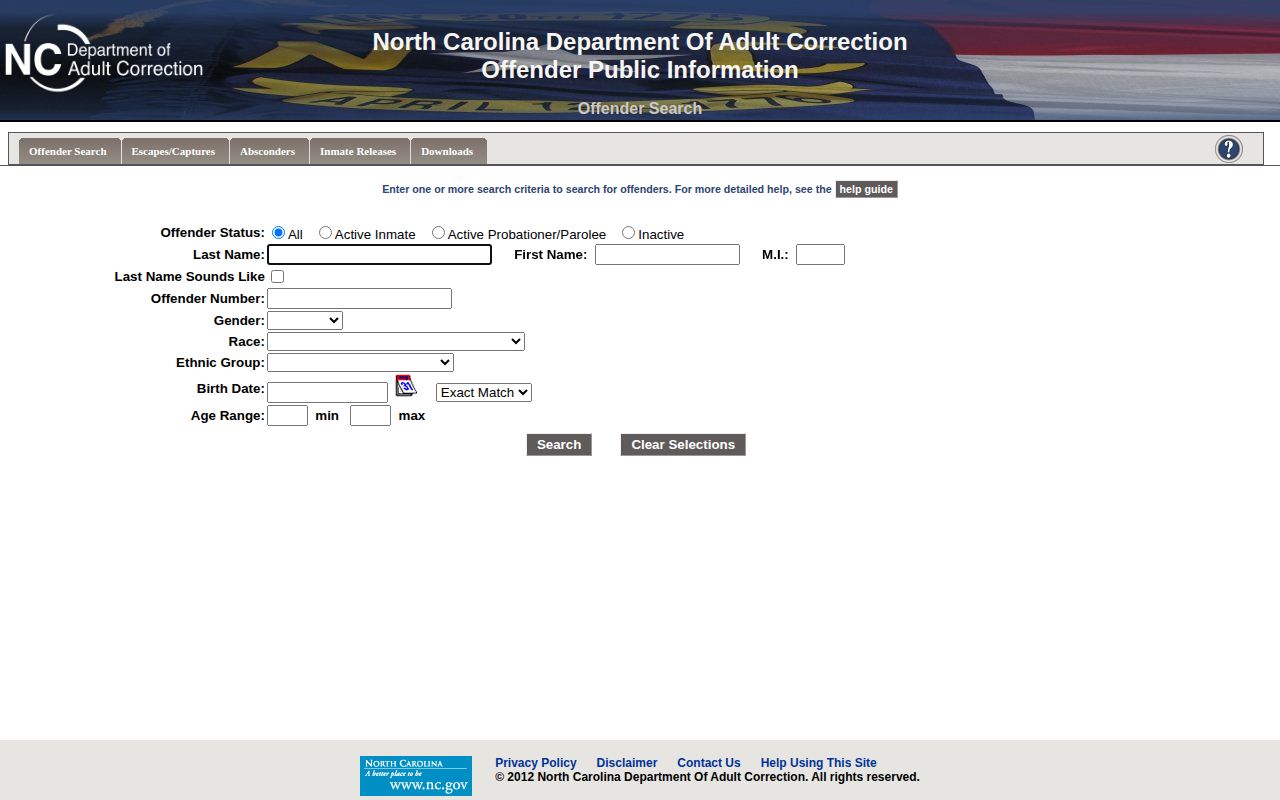
The form begins the match. The offender-number detail, incarceration period, sentence history, and movement fields supply the actual release context.
Columbus County Recent Release Limits
The Columbus County Sheriff's official site has no identified 24-hour list, 72-hour list, released tab, or searchable former-booking archive. Its In Custody page points to a Dropbox folder of dated PDF snapshots. On the research date, only April 29 and May 6 reports were present. Two files establish neither a weekly schedule nor an online retention period.
The official detention page documents the facility but not a historical release feed. Its captured view shows why a phone call and a narrow records request lead the local release workflow.
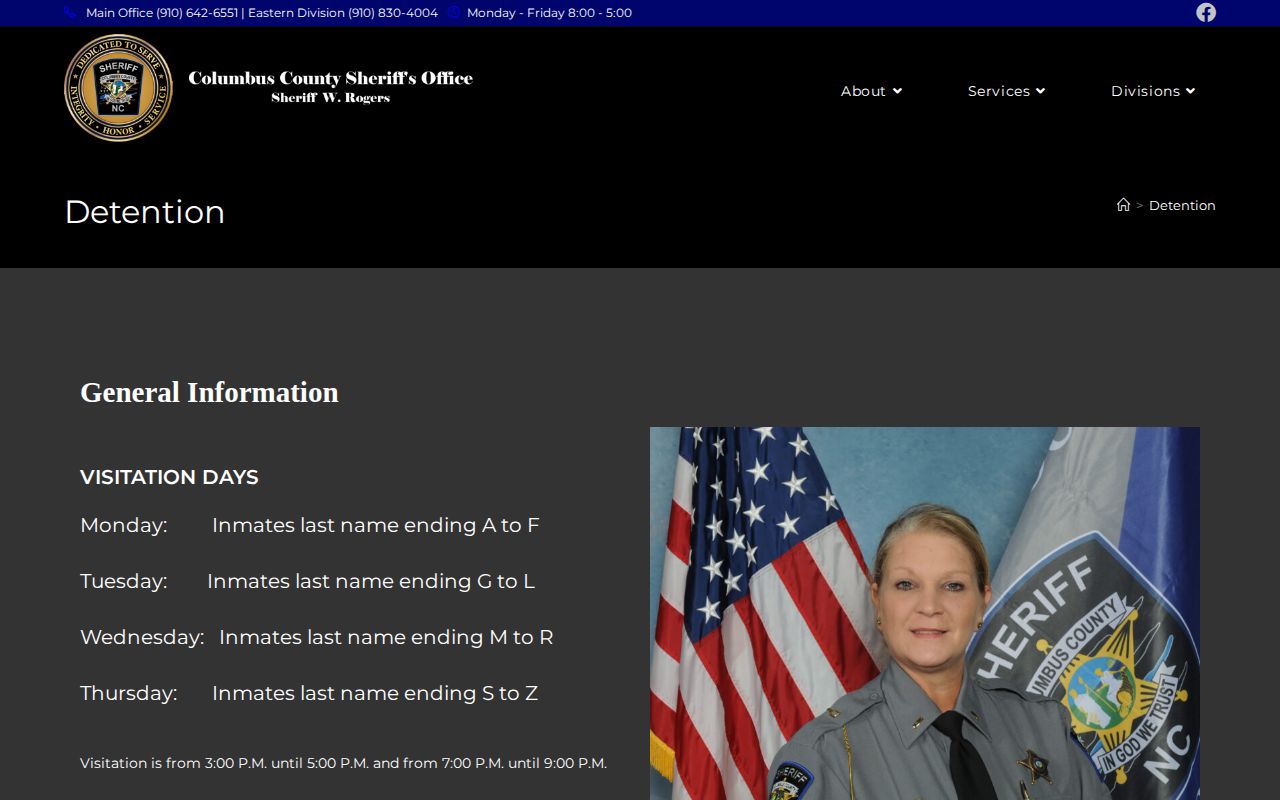
The page confirms the correct local custodian. It should not be read as a complete list of people released today or during any fixed window. The official Sheriff apps likewise advertise inmate search, alerts, contacts, sex-offender tools, and Most Wanted access, but no release archive or release-date field.
Columbus County Supervision After Release
The North Carolina Post-Release Supervision and Parole Commission sets conditions and performs statutory release and revocation functions. NCDAC Community Supervision supplies the field officers for probation, parole, and post-release supervision. Neither role belongs to the Sheriff's Office or to staff at Columbus CI or Tabor CI.
Modern Structured Sentencing felony cases generally move into statutory post-release supervision rather than discretionary parole. Older qualifying offenses committed before October 1, 1994 may remain parole eligible. Probation is a court-imposed status and can exist without a state-prison stay. Verify the person in Offender Public Information, read the supervision line separately from inmate status, and then use the current Community Supervision office directory. Active supervision means prison custody ended, not necessarily the full sentence.
Columbus County Federal Release Paths
NC SAVAN, also called VINELink, supplies custody-status information and alerts from participating North Carolina agencies. It is useful for change notices, not a complete archive. A “released” or “not in custody” event may not explain bond, transfer, another hold, or supervision. Confirm it with the Sheriff or NCDAC source record.
Federal custody uses a separate route. The Bureau of Prisons Inmate Locator covers federal prisoners released after 1982 and may show a release date and “RELEASED” location. U.S. Marshals pretrial custody has no comparable general public locator. Immigration custody uses the ICE Online Detainee Locator, which includes current detainees and some people released from ICE custody within the prior 60 days. A Columbus County jail exit to ICE or USMS is a transfer, not community release. Neither system should be mixed with NCDAC sentence rules.
Columbus County Release Status Compared
Each system answers a narrow question. Reading one as though it covered all custody levels is the main source of false release claims.
| Official channel | Best use | Key limitation |
|---|---|---|
| Sheriff In Custody Report | Present local jail cross-check | Absence does not prove release |
| Sheriff booking/release record | Physical exit from the county jail | May require a call or written request |
| eCourts and Clerk file | Bond, judgment, dismissal, probation, and disposition | May not show exact exit time |
| NCDAC offender detail | State incarceration, actual release, movement, and supervision | Does not hold local jail records |
| NC SAVAN | Custody and supervision event alerts | Not a complete historical record |
| BOP or ICE locator | Federal prison or immigration status | Separate coverage and time limits apply |
Does “inactive” mean fully discharged? Not by itself. Inactive inmate status may coexist with active parole or post-release supervision. Check the movement, actual date, release type, and supervision line together.
Columbus County Release Facilities
Three distinct facilities shape local searches. The Columbus County Detention Center is the county jail for pretrial custody and local terms. Its release record comes from the Sheriff, with the case outcome at the Clerk. Columbus Correctional Institution is a male medium-custody NCDAC prison with an official capacity of 780. Tabor Correctional Institution is a men's NCDAC prison with close and minimum custody. NCDAC reported about 1,300 people there during its January 2025 accreditation review.
Leaving either state prison does not itself prove release. A movement to another NCDAC location is a transfer. A valid state release check uses offender number, inmate status, last movement, actual release details, and any active supervision record. Facility staff can answer institution questions, while the NCDAC public-records office handles a formal historical request.
Which Columbus Facility Released Them?
“Columbus” can mean the county, the Columbus County Detention Center, or Columbus Correctional Institution. Tabor Correctional Institution also sits inside the county. That naming overlap makes custody-system identification the essential first step in a Columbus County release search. A Sheriff booking number leads to local detention records. An NCDAC offender number leads to statewide prison and supervision history.
Geography does not settle jurisdiction. A person may leave Columbus CI for Tabor CI, leave Tabor for a prison outside the county, or leave the county jail for state, federal, immigration, or another county's custody. Ask which agency received the person. Only a record showing community release, actual prison release, or full discharge supports that description.
Identifiers resolve the overlap. A local request should name the detention booking date, arresting agency, and court case. A state-prison check should use the NCDAC offender number, incarceration period, current or previous location, and movement date. If the person appears in both systems, place the events in date order. A Sheriff transfer entry can lead directly into an NCDAC admission without any time in the community.
When the systems disagree, preserve each displayed field and the date it was viewed. Compare the jail event with the court order, then compare any state movement with sentence history. Ask the records custodian to correct an error using the booking or offender number and the conflicting official document. A missing result is a reason to check names, aliases, dates, and custody level, not a reason to declare release.