
Columbus County Parole Differences
Parole, probation, and post-release supervision are separate legal statuses in North Carolina. Parole is conditional release before an eligible sentence expires. It mainly applies to older cases because Structured Sentencing ended traditional discretionary parole for offenses committed on or after October 1, 1994. Probation is imposed by a court and can exist without a prior state-prison term. Post-release supervision follows the prison portion of many modern felony sentences. In Columbus County, NCDAC Community Supervision supplies the field officers for all three groups, while the North Carolina Post-Release Supervision and Parole Commission sets post-release or parole conditions and performs statutory release and revocation functions.
The agency boundary matters. The Columbus County Sheriff's Office runs the detention center, but it does not supervise a person after a state-prison release. Columbus Correctional Institution and Tabor Correctional Institution hold state prisoners, yet prison staff are not the local field office after release. A court probation order, a Commission action, and an NCDAC status line may all concern the same person at different points.
| Status | How it begins | Official verification | How it ends |
|---|---|---|---|
| Parole | Commission grants conditional release in an eligible older case. | NCDAC offender detail plus Commission records. | Termination, sentence expiration, or another official action. |
| Probation | A court orders supervision instead of, or after, confinement. | NCDAC supervision status plus the Columbus County court file. | Court completion, discharge, modification, or revocation. |
| Post-release supervision | Statute places a sentenced felon under supervision after prison custody. | NCDAC offender detail and Community Supervision. | Completion shown by an inactive status or official discharge record. |
Definition: Discharge means the applicable custody or supervision obligation has formally ended. Leaving prison custody alone is not full discharge.
Verify Columbus County Parole Status
Use a full committed name and an offender number when possible. The NCDAC Offender Public Information search covers North Carolina state-prison offenders, probationers, and parolees. It does not hold local jail records. A former Columbus County Detention Center detainee appears there only if the case led to NCDAC custody or Community Supervision. Search results should be matched by birth information and other identifiers before a status is attributed to a person.
- Search by offender number, or enter the committed first and last name. Broaden spelling only when the exact search fails.
- Open the offender-number link for the matching person. Do not rely only on the results row.
- Read Inmate Status and Probation/Parole/Post Release Status as two distinct fields. An inactive inmate record can coexist with active supervision.
- Review the most recent incarceration summary, Last Movement, Last Movement Date, and sentence history. These fields separate prison release from transfer.
- If supervision is active, use the Community Supervision office directory to find the current responsible office.
- For probation, compare the NCDAC result with the Columbus County eCourts case and its probation, modification, violation, or completion entries.
The complete named-person release path is available on the Columbus County released-inmate search page. It helps when the first issue is whether a person left the county jail or entered state custody.
Note: Record the offender number, displayed status, and retrieval date because a supervision entry can change after a new official event.
Columbus County Supervision Office Route
Columbus County released state prisoners report through NCDAC Community Supervision, not the prison they left and not the Sheriff's Office. This local detail is easy to miss because two state prisons sit inside Columbus County. The statewide directory groups Columbus with Bladen and Brunswick in Judicial District 13 and lists a district office in Leland. Since the directory version and office assignments can change, verify the entry before travel or an in-person check. The Sheriff's contact page also lists a local Adult Probation telephone number, but it does not publish an address, hours, or check-in policy.
NCDAC Community Supervision
Judicial District 13 directory listing
324 Village Road, Unit G
Leland, NC 28451
910-755-3418
Local Adult Probation Contact
Listed by the Columbus County Sheriff's contact page
910-642-6531
Call to locate the proper office. No public check-in instructions were verified.
Use these channels to locate an office and confirm a public status. They are not routes to a private home address or confidential case notes. Provide the offender number and ask which office owns the supervision record. When an online result conflicts with a court entry, identify the exact fields and dates instead of asking staff to resolve a vague name match.
The Commission's official page explains its role. The directory handles field-office location. Keeping those roles separate prevents a call to the wrong agency.
Columbus County Supervision Terms
Short status words carry precise meanings. They should be quoted from the source and checked against the case. A person marked active under post-release supervision is physically out of prison but still serving the supervised part of a sentence. An inactive supervision entry is stronger completion evidence than silence on a jail roster. No single label should be stretched beyond what the agency reports.
- Parole
- Conditional release for a legally eligible sentence before its full expiration.
- Probation
- Court-ordered community supervision that may occur without a state-prison release.
- Post-release supervision
- The statutory supervised period that follows the prison portion of many felony sentences.
- Absconder
- An official supervision status tied to failure to remain in contact or comply, not mere absence from a website.
- Revocation
- An official process that can return a supervisee to custody after a violation finding.
- Discharge
- Formal completion or termination of the relevant supervision or sentence obligation.
Conditions vary by case. At a high level, they can require reporting, compliance with court or Commission orders, and observance of restrictions stated in the supervision plan. A suspected breach is not proof of a violation. The field officer, Commission, or court must use the applicable process.
Columbus County Absconder Checks
NCDAC Offender Public Information includes an absconder search route. It applies only after a Community Supervision record exists. No separate Columbus County Sheriff absconder list was found in the official sources reviewed. A missing address, a missed appointment reported by someone else, or an old social post does not establish absconder status.
Confirm the official NCDAC label first. Then check the court record or Commission channel for the event that explains it. NCDAC's Special Operations and Intelligence Unit maintains warrants for many fugitive probation and parole absconders, but the word “absconder” does not by itself prove which warrant, if any, is presently executable in Columbus County. Report only the exact public status.
Important: An active absconder status is not discharge and should never be treated as proof that supervision has ended.
Columbus County Parole Review Records
North Carolina does not publish a conventional calendar of public, face-to-face inmate parole hearings. Commissioners generally review files on their own and vote independently. A majority approves or denies a case. The monthly discretionary parole review page publishes reports beginning in September 2024. It is the official results route for older parole-eligible cases, not a schedule for modern Structured Sentencing release dates.
Published outcomes can include approval or denial. “Incomplete Decision” means more information is needed, such as an evaluation or investigation. “Suspend Decision” means further consideration stops at that time. Eligibility depends on the offense date and governing law. G.S. 15A-1371 addresses parole eligibility and procedure, while the Commission says pre-October 1994 cases may qualify subject to exclusions.
The Commission's victim guide describes weekly input appointments, not decision sessions. It says those meetings use 30-minute appointments for no more than five people. That meeting route must not be labeled a hearing calendar. To follow one Columbus County person, first match the offender number, then review the appropriate monthly report and contact the Commission if the public result needs context.
The official Commission overview shows the agency that makes these decisions.
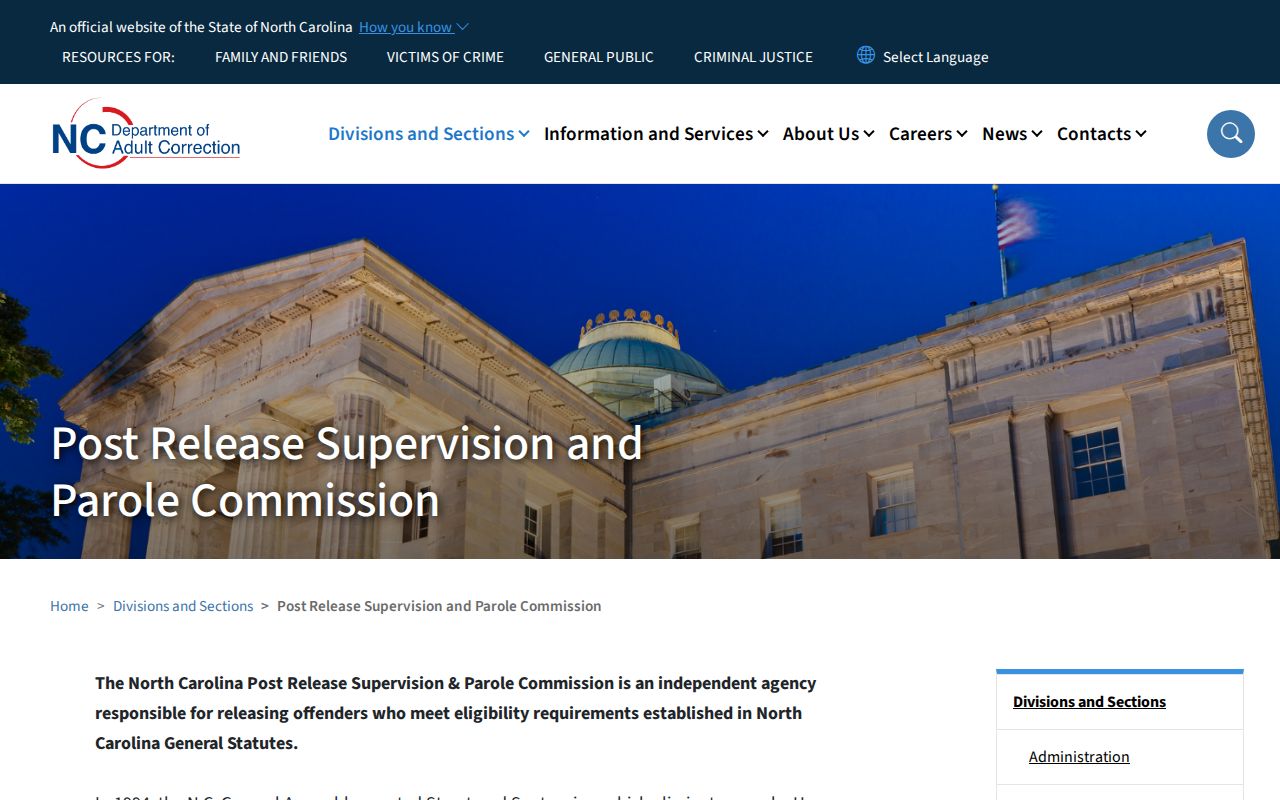
This source distinguishes Commission release functions from the work of Columbus County supervision officers.
Ending Columbus County Supervision
Release from prison and completion of supervision occur on different dates. Under G.S. 15A-1368.2(f), completion of post-release supervision terminates the sentence or sentences from which the person was placed on that supervision. Subsection (d) permits earned-time reduction for compliance with specified reintegrative conditions, up to 20 percent of the original supervision period. That rule affects supervision length, not the historical fact that prison custody ended earlier.
For a final check, look for an inactive supervision status or an official completion record. Compare it with the court file when probation is involved. NC SAVAN, also called VINELink, may provide change alerts through the North Carolina entry, but an alert is not an archival discharge certificate. Confirm it with NCDAC or the court that created the record.
Note: A completed prison term, an ended parole term, and a satisfied probation order may each have a different official date.