
Columbus County Three-Day Release Records
The Columbus County Sheriff's Office publishes no identified 72-hour release list. The official detention page is an information page, not a rolling record of former detainees. It offers no released tab, three-day filter, update schedule, or stated period for keeping former bookings online. The lack of a web feed means a date-bounded records request must replace the usual online window.
Ask whether the Sheriff's records custodian maintains an existing daily release log, jail-movement report, or booking report for the dates at issue. Use exact start and end dates. If no compiled report exists, narrow the request to the individual booking-and-release event. North Carolina law does not require an office to create a new compilation that it does not maintain, so the phrase "if maintained" keeps the request tied to existing records.
Check Columbus County 72-Hour Releases
A good three-day inquiry states the date range and the type of record sought. It also separates a group log from a named person's event. This distinction matters because an office may maintain individual booking records but no ready-made list of everyone who left during the period.
- Set the precise three-day span, including the first and last calendar dates.
- Check the Sheriff's current In Custody Report page only to see whether the person appears in a dated snapshot.
- Ask the Sheriff's records custodian for an existing daily release log, jail-movement report, or booking report covering that span, if one is maintained.
- If no group report exists, request one booking-and-release record by name, birth date, and approximate booking date.
- Ask the record to distinguish community release, bond, court order, sentence completion, and transfer to another custodian.
- Match the charge or case number through the Columbus County court page.
For activity limited to today, the Columbus County 24-hour release process emphasizes immediate phone confirmation. The three-day route gives more weight to a written date-bounded request because it may cover several custody events and more than one business day.
Note: Ask for an existing report if maintained, since the custodian is not required to compile a new three-day list.
Columbus County 72-Hour Release Fields
No public three-day table exists to inspect. The following fields come from the research inventory for a release-record request. They identify the person, tie the event to a booking, and explain whether the exit was a true community release or a transfer. Disclosure can vary, and no single Columbus County form is known to contain every field.
| Field to request | Why it matters |
|---|---|
| Committed name | Matches the name used in the detention record. |
| Booking number and booking time | Separates one custody episode from another. |
| Release date and time | Places the ending event inside or outside the three-day span. |
| Release authority or disposition | Describes the recorded basis for ending the jail episode. |
| Charge and case number | Connects the jail event with the court record. |
| Arresting agency | Helps resolve identity and agency responsibility. |
| Receiving custodian | Reveals a transfer that continued custody elsewhere. |
Bond information may also be requested where public. Do not read bond release as an acquittal. It ends the jail stay while the case continues. Likewise, a court dismissal may explain release, but the court file is the durable source for what happened to the charge.
Columbus County Weekend Release Checks
A three-day period is useful around weekends because it keeps the request from focusing on only one calendar day. Yet the wider span does not cure data lag by itself. A phone statement can be timely, while an event may take longer to appear in a report, court system, or notification service. Holidays can also delay access to administrative staff without changing the actual release time.
Set the date range from the event you are trying to verify, not from when someone first noticed a missing roster entry. Ask for the physical release date and time recorded by the detention center. Then request the release authority and receiving custodian. This catches a late-posted event while preserving the key distinction between leaving the county jail and leaving all custody.
If a court order or bond action occurred during the period, check the case file. The case can explain the legal basis for the exit, but it may not record the exact minute the person left. For that reason, the jail event and court disposition work best together. Administrative office closures may affect when a written request is handled, but they do not prove that detention operations stopped or that a person left early. Use the event record rather than assumptions about weekend timing.
Columbus County Snapshot Report Limits
The distinctive local source is a Dropbox folder of dated In Custody Report PDFs. On the research date, the folder held an April 29 report and a May 6 report. Two snapshots do not prove a weekly schedule, a complete archive, or any retention rule. They also do not create a recent-release feed.
The Sheriff detention page behind the local workflow is shown below. Its official source is useful for identifying the responsible facility, while its lack of a former-booking search explains why records contact must lead.
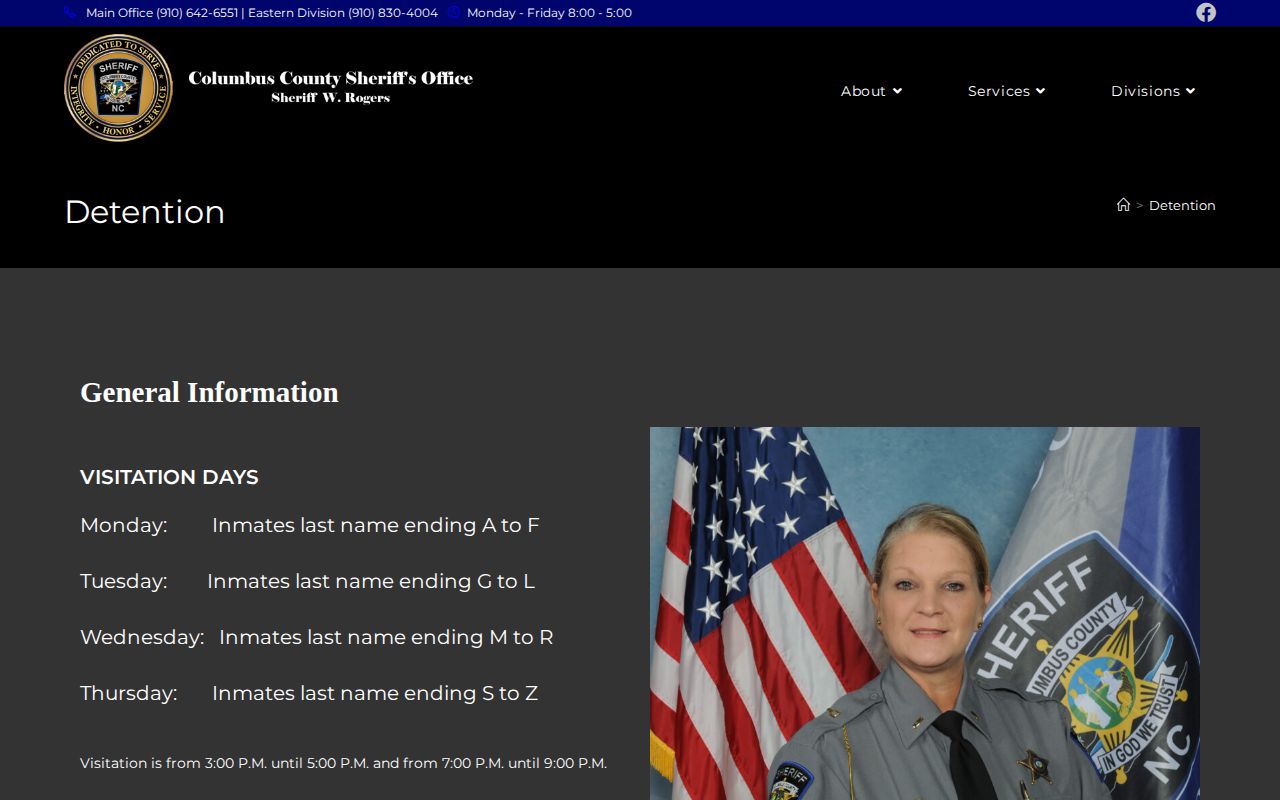
The screenshot does not prove that no internal release log exists. It proves only that the public page is informational rather than an exposed three-day search. Ask the custodian whether a log exists for the fixed range. If it does not, shift to individual records instead of inferring releases from names missing between snapshots.
Note: A person absent from a later custody snapshot may have transferred, so the ending event and receiving custodian still require confirmation.
Columbus County Release Fallback Chain
When no compiled three-day log exists, use the sources in custody order. The Columbus County Detention Center record comes first for a sheriff booking. The court file follows because it can show the bond order, dismissal, judgment, custody-day calculation, probation order, or other disposition. NC SAVAN is the notification channel, but its event should be verified with the agency that supplied the custody data.
- County jail event
- Ask the Sheriff for the existing booking-and-release record and its ending event.
- Court result
- Use eCourts Portal or the Clerk's file to confirm the legal action tied to the case.
- State transfer or release
- Use NCDAC Offender Public Information for incarceration, movement, and supervision status.
- Notification
- Use NC SAVAN for participating custody-change alerts, then confirm at the source.
If NCDAC shows an inactive inmate status with an actual terminating movement, the person may have left state prison. That is not a Columbus County jail release merely because a state prison sits in the county. Columbus Correctional Institution and Tabor Correctional Institution are state facilities, and their releases belong to the statewide record.
NCDAC's separate Inmate Releases search can discover state releases by month and destination county. Its Columbus filter is not a list of exits from facilities located in Columbus County. Read the person-level offender history to confirm an actual release date, release type, movement, and any active supervision. This prevents a statewide destination list from being mistaken for the missing local three-day jail feed.
Verify the Columbus County Release Window
Finish by reconciling dates and systems. The jail event should identify when the booking ended. The court record should explain the legal disposition when one exists. A state or federal record should be checked when the person went to another custodian. If the three-day span includes several possible events, keep the booking number and case number with each result.
For a named person whose history reaches beyond the requested span, use the full Columbus County release-record route. That route is better suited to older cases, aliases, repeated bookings, and the difference between county detention and the two state prisons located here.
Do not convert a missing online name into a finding. The Sheriff's web sources are current-custody snapshots, not a former-inmate archive. A written event record is the durable proof. A phone confirmation can help when speed matters, but the recorded date, authority, and destination provide the context a three-day search needs.
Keep the boundaries of the requested period clear in the final result. If an event occurred just before or after the span, report that recorded date rather than forcing it into the three-day window. If the source date and notification date differ, preserve both and note which agency supplied each. That makes a processing delay visible without inventing an update cadence the Sheriff has never published.
Note: Web visibility is not record retention; ask the custodian for the underlying event even when no dated PDF remains online.